


Underground Utility Damage Insurance for Locating Contractors

or call us: (858) 384‑1506
A single mislocated gas line or unmarked fiber conduit can turn a routine day into a six-figure liability event. For
utility locating contractors, the margin between a clean job and a catastrophic strike is measured in inches, and the financial fallout from getting it wrong extends far beyond the cost of a repair. Underground utility damage
costs the U.S. economy $83.2 billion annually, with direct repair expenses accounting for only about 5.9% of that total. The rest?
Business interruption, emergency response, environmental remediation, lawsuits, and regulatory fines. If you're a locating contractor, understanding how damage claims work, what your insurance actually covers, and where the gaps hide isn't optional. It's the difference between staying in business and watching it collapse after one bad day. This guide breaks down the full picture of underground utility damage claims for locating contractors: the types of strikes that trigger them, how to report and document incidents, what your policies cover (and don't), and the exclusions that catch most contractors off guard.
Understanding Liability in Underground Utility Strikes
Liability in utility strikes isn't always straightforward. The locating contractor, the excavator, the facility owner, and even the one-call center can share blame depending on the circumstances. Your exposure depends on what you marked, how you marked it, and whether you followed accepted standards like ASCE 38-22 classification levels.
Most states follow a comparative negligence framework, meaning fault is split between parties. But here's the catch: locating contractors often sit at the center of disputes because their work product, the locate marks, is what everyone else relies on. If those marks are wrong, you're the first name on the claim.
Common Risks for Gas, Electric, and Fiber Locators
Gas line strikes carry the highest severity risk. A ruptured gas main can cause explosions, evacuations, and fatalities, and the resulting claims often reach seven figures. Electric strikes create electrocution hazards and can trigger widespread outages with cascading business interruption claims from affected customers.
Fiber and telecom strikes have historically been treated as lower-priority incidents, but that's changed fast. Fiber optic repair costs have increased sharply since early 2026, and a single severed trunk line can knock out service for hospitals, data centers, and financial institutions. The resulting business interruption claims can dwarf the physical repair bill.
Water and sewer strikes bring their own headaches: flooding, contamination, boil-water advisories, and environmental cleanup costs that can drag on for weeks.
The Role of Potholing and Positive Identification
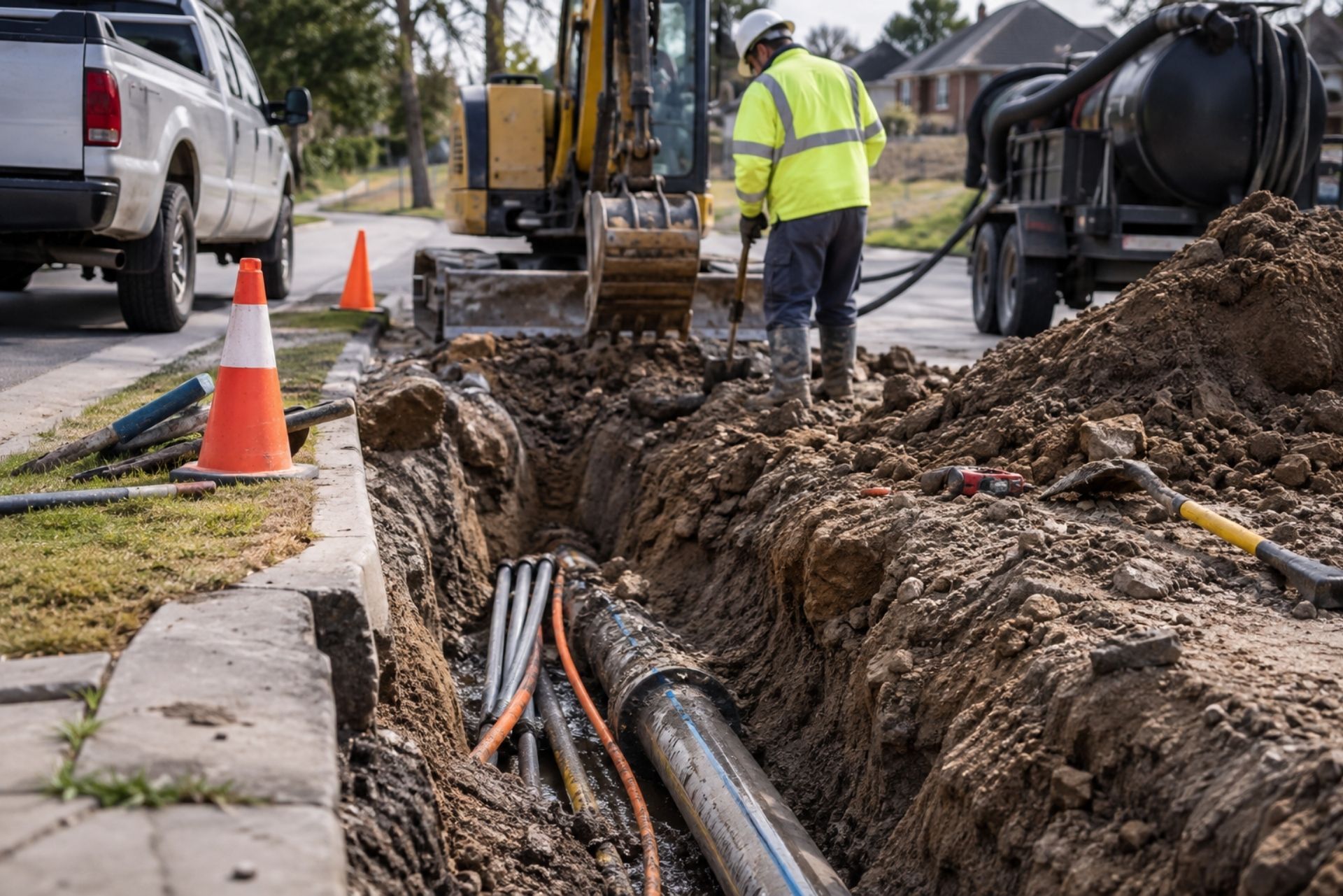
Potholing, whether through vacuum excavation or hand-digging, is the gold standard for confirming utility location before full excavation begins. It's also one of the strongest defenses you can present in a claim dispute.
If you potholed and documented the results, you've demonstrated a higher standard of care. If you relied solely on electromagnetic or GPR locating without positive identification in a congested utility corridor, a claims adjuster or opposing attorney will use that against you. Many contracts now require potholing in specific conditions, and failing to meet those contractual obligations creates both liability and coverage problems.

Critical Insurance Coverages for Locating Contractors
Standard business insurance doesn't account for the specific risks locating contractors face. You need coverage built around the reality that your work product, an invisible mark on the ground, can cause millions in damages if it's wrong by even a few inches.
General Liability vs. Professional Liability (Errors & Omissions)
General liability covers bodily injury and property damage caused by your operations. If your crew's vacuum truck backs into a parked car, that's a GL claim. But if you mismark a gas line and an excavator hits it three days later, that's a professional liability (E&O) claim, because the damage resulted from your professional service, not your physical presence.
This distinction trips up locating contractors constantly. We've seen clients at Fusco Orsini & Associates come in after a denied claim, confused about why their GL policy didn't cover a mislocate. The answer is almost always the same: GL covers what you physically do on-site, while E&O covers the accuracy and reliability of your professional work product.
You need both. Period.
Comparison Table: Standard GL vs. Specialized Locating Policies
| Coverage Feature | Standard GL Policy | Specialized Locating Policy |
|---|---|---|
| Bodily injury from operations | Covered | Covered |
| Property damage from mislocates | Typically excluded | Covered under E&O |
| Third-party business interruption | Rarely covered | Available as endorsement |
| Contractual indemnity obligations | Limited | Broader coverage options |
| Potholing/vacuum excavation | May require separate endorsement | Typically included |
| Pollution from utility strikes | Excluded | Available via pollution endorsement |
| Defense costs | Included in limits (erodes coverage) | Often outside limits |
A specialized policy designed for locating contractors is the only way to close these gaps. Generic business insurers often don't understand the risk profile, which leads to underwriting errors and denied claims.
How you handle the first 24 hours after a utility strike determines the trajectory of the entire claim. Delays, missing documentation, or incomplete reporting can turn a defensible incident into an uninsured loss.
Immediate Steps After a Utility Strike Occurs
The moment a strike occurs, your priority sequence should look like this:
- Ensure safety. Evacuate if there's a gas leak or electrical hazard. Call 911 if anyone is injured.
- Notify the facility owner and one-call center immediately.
- Contact your insurance carrier or broker. Don't wait until you "know more." Late reporting is one of the most common reasons claims get denied.
- Preserve the scene. Don't allow anyone to alter, cover, or repair the damage before it's been documented.
- Identify witnesses and collect their contact information.
Speed matters. Many policies have strict reporting windows, some as short as 48 hours for incidents involving critical infrastructure.
Documentation Requirements: Photos, Logs, and GPS Data
Your documentation is your defense. Adjusters, attorneys, and facility owners will reconstruct the incident using whatever records exist, and if yours are thin, their version of events wins.
Capture time-stamped photos of the strike location, your existing locate marks, and the surrounding area. Pull GPS data from your locating equipment showing where and when you performed the locate. Retrieve your field logs, including the ticket number, locate request details, and any notes about difficult conditions like congestion or signal interference.
The CGA's annual DIRT data reports consistently show that poor documentation is a contributing factor in disputed claims. If you can't prove what you did and when you did it, you're fighting uphill.
Common Policy Exclusions to Watch For
Every insurance policy is defined as much by what it excludes as by what it covers. For locating contractors, two exclusions cause more claim denials than all others combined.
The 'Care, Custody, and Control' Limitation
Most GL policies exclude damage to property in your care, custody, or control. For locating contractors, this exclusion gets applied in unexpected ways. If you're performing potholing and your vacuum excavation equipment damages a utility line you're exposing, the insurer may argue that line was in your "care" at the time.
This exclusion can also apply when you're contracted to locate and protect specific utilities during an excavation project. The utility you're responsible for monitoring may be considered under your control, meaning damage to it falls outside your GL coverage.
Talk to a broker who understands this distinction. At Fusco Orsini & Associates, we specifically review care, custody, and control language in every policy we place for locating contractors because the standard wording almost never works in your favor without modification.
Contractual Liability and Indemnity Gaps
Many locating contractors sign subcontracts or master service agreements that include broad indemnification clauses. You agree to hold the general contractor or facility owner harmless for damages, even those partially caused by their own negligence.
Here's the problem: standard GL policies exclude liability assumed under contract unless it qualifies as an "insured contract." Broad-form indemnity obligations often don't qualify. That means you've contractually accepted liability that your insurance won't cover.
Review every indemnification clause before you sign. If the language is one-sided, negotiate it or confirm with your broker that your policy will respond. New federal regulatory guidance on damage prevention is pushing for clearer allocation of responsibility, but contracts still override general principles in most disputes.
Frequently Asked Questions About Utility Damage Claims
Who is responsible if the utility map was incorrect?
The facility owner typically bears responsibility for providing accurate maps and records. If you performed your locate based on faulty as-built drawings, you may have a strong defense, but only if you can show you followed standard procedures with the information available. Documentation of what records you received and from whom is critical.
Does my insurance cover the cost of service interruption for fiber lines?
Standard GL policies usually don't cover third-party business interruption from a fiber strike. You'll need a specific endorsement or a specialized policy that includes this coverage. Given that fiber outage claims can reach hundreds of thousands of dollars, this is't optional for contractors working near telecom infrastructure.
What happens if I miss a mark but no damage occurs immediately?
A latent mislocate can still trigger a claim months later if subsequent work or ground movement causes a failure at the unmarked location. Your E&O policy's claims-made trigger date and retroactive date determine whether you're covered. Report potential issues to your carrier as soon as you become aware of them.
Do I need a separate policy for vacuum excavation work?
It depends on your existing coverage. Some GL policies include potholing and vacuum excavation as covered operations. Others exclude mechanical excavation entirely. Check your policy's operations description carefully, and if vacuum excavation isn't explicitly listed, get an endorsement or separate coverage.
Why did my claim get denied even though I have General Liability?
The most common reason is that the claim involved a professional error, like a mislocate, which GL doesn't cover. GL responds to operational accidents, not mistakes in your professional judgment or service delivery. You need E&O coverage for mislocate claims. The second most common reason is late reporting or failure to meet policy conditions.
Protecting Your Business Long-Term
The locating industry is evolving fast. New damage prevention technologies like augmented reality mapping and AI-assisted locate verification are raising the standard of care, which means insurers and courts will increasingly expect you to use them.
Your next steps should be concrete. Pull out your current policy and check for the exclusions we've covered here: care, custody, and control; contractual liability; professional services. If any of those gaps exist, you're exposed. Review your subcontracts for indemnification language that outpaces your coverage. And build a documentation protocol that captures GPS data, photos, and field notes on every single locate, not just the ones that feel risky.
If you're unsure whether your current coverage matches the work you're actually performing, bring your policy to a broker who specializes in this space. The team at Fusco Orsini & Associates works with locating contractors across the country and can identify gaps that generalist agents miss. One policy review now is worth far more than one denied claim later.
About The Author:
Michael Fusco
As CEO and Principal of Fusco Orsini & Associates, I’m dedicated to helping businesses and individuals achieve peace of mind through smarter insurance solutions. With extensive experience in commercial insurance and risk management, I focus on building long-term relationships and providing clarity, trust, and value in every policy we deliver.
// Coverage for Your Company
Protect Your Business, Employees, and Assets
We help business owners protect their companies from risks that can disrupt operations or threaten growth. Our team explains your options clearly and guides you to the right coverage for your business.
// Who We Help
Focused Insurance for Your Industry
We understand the unique risks and needs of different industries. Our team provides clear guidance and customized coverage to help you operate with confidence.


// Coverage for Individuals and Families
Protect What Matters Most at Home and Beyond
Renters Insurance
Affordable protection for your personal property in a rented space.
Life Insurance
Ensure your loved ones are financially secure when they need it most.
Umbrella Insurance
Extra liability coverage to protect you beyond standard policies.

// Frequently Asked Questions
Clear Answers to Common Questions

5.0 Reviews on Google
What You Need to Know Before Getting Started
People often ask us about the most common questions around business consulting, insurance, and employee benefits.
What types of insurance does my business need?
We evaluate your operations, identify risks, and explain the policies that make sense for your business. Our goal is to help you understand what you’re buying and ensure nothing important is overlooked.
The right coverage depends on your industry, size, and exposures. We’ll walk you through each option and help you make a confident decision.
Do you provide employee benefits?
Yes. Our dedicated benefits team offers group health, dental, vision, life, and disability plans. We also help employees with claims and explain how to use their benefits effectively.
We design plans that meet your company’s goals while keeping costs manageable and ensuring employees feel supported.
Do you only serve clients in California?
No. While we are based in San Diego, California, we work with clients in 31 states across the country.
We have the licenses and experience to support businesses of all sizes wherever they operate.
Can you review my existing policies?
Absolutely. We offer policy reviews at no cost to you. We’ll look for gaps in coverage, overlapping policies, and opportunities to save money.
Our team makes transitioning from your current provider simple and seamless.
How quickly can I get a quote?
In most cases, we respond the same business day with clear options and next steps.
We know that time matters, and we work efficiently to provide you with answers and coverage without unnecessary delays.
// What Our Clients Say
Reviews from Business Owners Like You
Over 500 Five-Star Ratings Across Platforms
// Business Tips & Resources
Helpful Articles for Business Owners
Our blog offers clear advice to help you protect your business, support your employees, and plan for the future with confidence.


Contact Us
Phone
Location