



California
Utility Locator Errors and Omissions Insurance

or call us: (858) 384‑1506
A single mismarked gas line can shut down a city block, trigger an evacuation, and land your locating company in a lawsuit before the dust settles. In California, where underground infrastructure is dense and aging, the margin for error is razor-thin. Roughly 68% of construction damages trace back to improper utility locating and excavation practices, with about two-thirds of those errors tied specifically to inaccurate marking or failure to identify existing utilities. That's not a fringe risk; it's the central hazard of the profession.
If you run a
utility locating business in California,
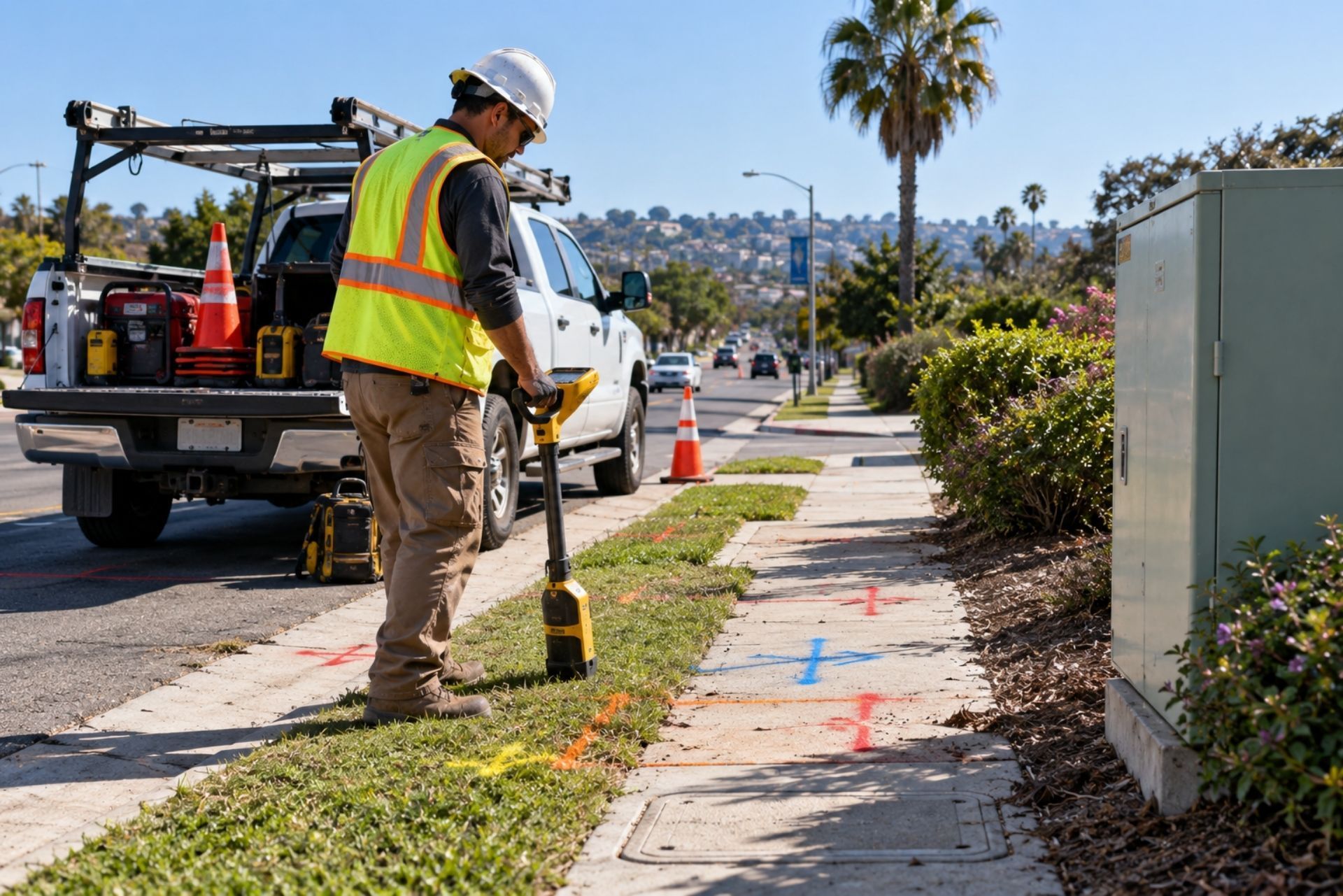
errors and omissions insurance isn't optional in practice, even if no statute literally mandates it. E&O coverage protects you when your professional work product, whether it's a mark on the ground, a GIS layer, or a written report, turns out to be wrong and someone gets hurt or suffers financial loss. This guide breaks down the coverage specifics: what policies actually protect, how claims unfold, what limits and deductibles make sense, and where California's regulatory environment creates unique exposure. Whether you're a one-person GPR operator or a multi-crew firm handling municipal contracts, the stakes are the same.
Understanding Errors and Omissions (E&O) for California Utility Locators
E&O insurance, also called professional liability insurance, covers claims arising from mistakes in your professional services. For utility locators, that means protection when your locate is wrong, your map is inaccurate, or you miss an underground line entirely. The policy pays for legal defense costs and any resulting settlement or judgment, up to your policy limits.
This coverage is distinct from general liability, which handles bodily injury or property damage caused by your physical operations. E&O fills the gap between what you did with your hands and what you did with your expertise. A contractor who hits a gas line because your marks were off by three feet isn't suing over a slip-and-fall; they're suing because your professional judgment failed.
Why General Liability Isn't Enough for Professional Mistakes
General liability policies contain a professional services exclusion. If a claim stems from an error in your locating work, your GL carrier will deny it. This is the professional liability gap that many business owners don't recognize until a claim hits.
Think of it this way: your GL policy covers you if your equipment falls off a truck and damages a car. It won't cover you if your electromagnetic locate misidentifies a fiber optic line as abandoned, leading to a severed cable and a $400,000 service outage claim. That second scenario is squarely an E&O matter. Without the right policy, you're paying defense costs and damages out of pocket.
State-Specific Risks: California's Dig Alert and Government Regulations
California's regulatory framework around underground utilities is more aggressive than most states. The state's DigAlert (USA North and South) system requires a locate request before any excavation, and locators who respond to those tickets carry significant liability for accuracy. Governor Newsom signed SB 778 to strengthen excavation safety and expand enforcement, which means penalties for inaccurate locates are getting stiffer, not lighter.
The California Public Utilities Commission also maintains oversight of gas and electric utility mapping standards, and recent filings show increased scrutiny of locate accuracy in high-consequence areas. DigAlert's own
2026 procedural changes are tightening timelines and documentation requirements. If you're operating without E&O coverage in this environment, you're betting your business on never making a mistake.


Core Coverage: Incorrect Marks, Missed Utilities, and Mapping Errors
E&O policies for utility locators typically cover three primary categories of professional error: incorrect marking of utility locations, complete failure to identify a utility (missed lines), and errors in mapping, GIS data, or written reports. Each category carries its own risk profile and potential claim size.
Incorrect marks are the most common trigger. You locate a water main and mark it two feet south of its actual position. The excavator digs based on your marks, hits the line, and floods a basement. Your E&O policy responds to the resulting property damage claim and your legal defense.
The Financial Impact of Missed Underground Lines
Missed utilities carry the highest consequence potential. A completely unidentified gas line or high-voltage conduit can cause explosions, electrocutions, and deaths. Claims in these scenarios routinely exceed $1 million, and in California's plaintiff-friendly courts, verdicts can go much higher.
Even non-catastrophic misses are expensive. A missed telecommunications conduit on a highway project can trigger weeks of construction delays, with the general contractor looking to recover those costs from whoever signed the locate report. Defense costs alone in complex construction disputes often run $50,000 to $150,000 before you even get to a settlement. Firms working in high-traffic urban corridors, think Los Angeles, San Francisco, or San Jose, face these scenarios regularly. This is exactly the kind of exposure that Fusco Orsini & Associates helps locating companies evaluate during coverage reviews.
Liability for Faulty GIS Data and Record Discrepancies
If your firm provides subsurface utility engineering (SUE) services or delivers GIS-based mapping products, your exposure extends beyond field marks. Errors in digital deliverables, whether from misinterpreted GPR data, incorrect coordinate entries, or reliance on outdated utility records, can create liability that persists for years.
A flawed GIS layer delivered to a municipality might be referenced by dozens of contractors over multiple projects. Each time someone relies on your inaccurate data and suffers a loss, that's a potential claim. Some E&O policies limit coverage for "prior work" or include sunset clauses. You need to understand your policy's retroactive date and how it handles claims arising from work completed years earlier. Choosing a locator with proper insurance and credentials is one reason sophisticated clients vet their
subcontractors carefully.
Comparison: Professional Liability vs. General Liability
Understanding the difference between these two policy types is critical. Here's a side-by-side breakdown:
| Feature | General Liability (GL) | Professional Liability (E&O) |
|---|---|---|
| Covers | Bodily injury, property damage from operations | Errors, omissions, negligent acts in professional services |
| Trigger | Physical incident (slip, fall, equipment damage) | Professional mistake (wrong mark, missed line, bad report) |
| Typical Limits | $1M per occurrence / $2M aggregate | $500K to $5M per claim / aggregate |
| Claims Basis | Occurrence-based (covers incidents during policy period) | Claims-made (covers claims filed during policy period) |
| Defense Costs | Usually outside the limit | Often inside the limit (erodes coverage) |
| Required by | Most contracts, lease agreements | Increasingly required by GCs and municipalities |
One critical distinction: most E&O policies are claims-made, meaning they only cover claims reported while the policy is active. If you cancel your policy and a claim surfaces six months later for work you did last year, you have no coverage. That's why tail coverage (also called an extended reporting period) matters when you retire, sell, or change carriers.
Selecting appropriate limits and deductibles for your E&O policy isn't guesswork. It should be driven by the size and type of projects you handle, the contracts you sign, and your firm's financial capacity to absorb risk.
Choosing the Right Limit for High-Density Urban Projects
Most utility locating firms in California carry E&O limits between $1 million and $3 million per claim. For firms working on major infrastructure projects in metro areas, $2 million or higher is increasingly the minimum that general contractors and public agencies will accept.
If you're locating for a CalTrans project or a Bay Area transit expansion, your contract almost certainly specifies minimum E&O limits. Falling short means losing the bid. Fusco Orsini & Associates regularly works with locating companies to match their limits to the contract requirements they're pursuing, rather than defaulting to the cheapest option. The cost difference between $1 million and $2 million in coverage is often modest compared to the revenue a single large contract generates.
How Deductibles Affect Your Premium and Out-of-Pocket Risk
Your deductible is the amount you pay out of pocket before your E&O policy kicks in. Typical deductibles for locating firms range from $2,500 to $25,000 per claim. A higher deductible lowers your annual premium but increases your financial exposure on each claim.
California's small deductible plan guidelines for workers' compensation offer a useful parallel: the principle of trading premium savings for retained risk applies across insurance types. For a firm handling 500 locates a month, a $10,000 deductible might make sense because you can absorb occasional small claims. A solo operator doing 30 locates a month should probably keep the deductible lower, even if it costs more in premium.
Managing the Claims Process in California
When a claim hits, your response in the first 48 hours matters enormously. E&O policies require prompt notification to your carrier, often as soon as you become aware of a potential claim or even a "circumstance" that could lead to one.
Don't wait for a formal lawsuit. If a contractor calls and says your marks were wrong and they hit a line, report it to your insurer immediately. Late reporting is one of the most common reasons carriers deny E&O claims. Your policy language will specify the notification window, and California courts have upheld denials for late notice.
Once you've reported, your carrier assigns defense counsel. You typically don't get to pick your own attorney unless your policy includes a "consent to settle" or "choice of counsel" provision. Cooperate fully with the investigation. Preserve all field notes, GPS data, photos, and ticket documentation. The locators who survive claims are the ones with bulletproof documentation habits. Industry forums are full of experienced locators emphasizing that thorough records are the single best defense against disputed claims.
Frequently Asked Questions About Locator Insurance
Does California law require utility locators to carry E&O insurance? No state statute mandates it, but most municipal contracts, general contractor agreements, and DigAlert member obligations effectively require it. Operating without E&O coverage is a financial risk most firms can't justify.
How much does E&O insurance cost for a California locating company? Premiums typically range from $3,000 to $15,000 annually, depending on revenue, claim history, services offered, and chosen limits. Firms providing SUE or GPR-based deliverables generally pay more than basic electromagnetic locators.
What's the difference between claims-made and occurrence-based E&O policies? Claims-made policies cover claims filed during the active policy period. Occurrence-based policies cover incidents that happened during the policy period, regardless of when the claim is filed. Most E&O policies for locators are claims-made.
Will my E&O policy cover damage to the utility itself? It depends on the policy. Some E&O forms exclude direct physical damage to underground infrastructure and treat that as a GL matter. Others include it. Read your policy carefully or have a specialist like Fusco Orsini & Associates review it.
Can I get E&O coverage if I've had a prior claim? Yes, though your options narrow and premiums increase. Carriers specializing in utility locating and ground penetrating radar insurance are more experienced at underwriting firms with claim history than generalist insurers.
Does E&O cover me if I relied on inaccurate utility records from the owner? Potentially. If you can demonstrate you followed industry standards and the error originated in records provided to you, your defense position is stronger. Your E&O policy would still cover your defense costs while this is sorted out.
Making the Right Choice for Your Locating Business
Your locating business faces a unique combination of professional risk that most insurance agents don't fully understand. E&O coverage for utility locators in California isn't a box to check; it's the policy that stands between a bad day on a job site and the end of your company.
Get specific about your exposure. Review your contracts for minimum insurance requirements. Understand whether your policy is claims-made or occurrence-based, and know your retroactive date. Check whether defense costs sit inside or outside your limits, because that distinction can cut your effective coverage in half.
If you haven't had your
E&O policy reviewed by a specialist familiar with California's locating industry, now is the time. Reach out to Fusco Orsini & Associates for a coverage audit tailored to your operations, your contract requirements, and the real-world risks you face every time you put marks on the ground.
About The Author:
Michael Fusco
As CEO and Principal of Fusco Orsini & Associates, I’m dedicated to helping businesses and individuals achieve peace of mind through smarter insurance solutions. With extensive experience in commercial insurance and risk management, I focus on building long-term relationships and providing clarity, trust, and value in every policy we deliver.
// Coverage for Your Company
Protect Your Business, Employees, and Assets
We help business owners protect their companies from risks that can disrupt operations or threaten growth. Our team explains your options clearly and guides you to the right coverage for your business.
// Who We Help
Focused Insurance for Your Industry
We understand the unique risks and needs of different industries. Our team provides clear guidance and customized coverage to help you operate with confidence.



// Coverage for Individuals and Families
Protect What Matters Most at Home and Beyond
Renters Insurance
Affordable protection for your personal property in a rented space.
Life Insurance
Ensure your loved ones are financially secure when they need it most.
Umbrella Insurance
Extra liability coverage to protect you beyond standard policies.

// Frequently Asked Questions
Clear Answers to Common Questions

5.0 Reviews on Google
What You Need to Know Before Getting Started
People often ask us about the most common questions around business consulting, insurance, and employee benefits.
What types of insurance does my business need?
We evaluate your operations, identify risks, and explain the policies that make sense for your business. Our goal is to help you understand what you’re buying and ensure nothing important is overlooked.
The right coverage depends on your industry, size, and exposures. We’ll walk you through each option and help you make a confident decision.
Do you provide employee benefits?
Yes. Our dedicated benefits team offers group health, dental, vision, life, and disability plans. We also help employees with claims and explain how to use their benefits effectively.
We design plans that meet your company’s goals while keeping costs manageable and ensuring employees feel supported.
Do you only serve clients in California?
No. While we are based in San Diego, California, we work with clients in 31 states across the country.
We have the licenses and experience to support businesses of all sizes wherever they operate.
Can you review my existing policies?
Absolutely. We offer policy reviews at no cost to you. We’ll look for gaps in coverage, overlapping policies, and opportunities to save money.
Our team makes transitioning from your current provider simple and seamless.
How quickly can I get a quote?
In most cases, we respond the same business day with clear options and next steps.
We know that time matters, and we work efficiently to provide you with answers and coverage without unnecessary delays.
// What Our Clients Say
Reviews from Business Owners Like You
Over 500 Five-Star Ratings Across Platforms
// Business Tips & Resources
Helpful Articles for Business Owners
Our blog offers clear advice to help you protect your business, support your employees, and plan for the future with confidence.


Contact Us
Phone
Location