


Does my small business need a business continuity plan?
See How We're Different
or call us: (858) 384‑1506
A business continuity plan example would include various components, such as a risk assessment, plans for restoring systems, roles that outline who will do what, and more.
A business continuity plan (BCP) is your proactive strategy for keeping your business running if something goes wrong. Some examples of “what could go wrong” include natural disasters, cyberattacks, supply chain failures, pandemics, utility outages, tariffs impacting manufacturing, and more.
If you are a business owner in 2025, there’s a good chance you’ve read about some “crazy” circumstances happening to other businesses. You could rattle off the names of those businesses and identify which sank and which swam. Business owners never want to find themselves in sinking situations. Yet still, a false sense of security keeps many folks from taking necessary precautions.
At Fusco Orsini & Associates Insurance Services, we strongly recommend that our business clients consider business continuity plans to position themselves as ready and resilient.
Why do you need a business continuity plan?
According to Zywave, BCPs “establish a recovery and remediation framework to help organizations limit possible damage and ensure crucial business functions can continue when various disasters and emergencies strike.”
If you’re thinking, “Eh, my business is too small to need something like that,” keep reading. That is the first myth about BCPs, and we’re here to bust a few more.
Myth: Only large corporations or those prone to natural disasters need BCPs.
Small businesses often have limited capital, which is one of the biggest reasons they should get a BCP. According to Zywave, “multiple studies found that between 40% and 60% of small businesses fail shortly after experiencing a crisis.” A BCP can help you protect your profits, people, and operations and bounce back when a disruption occurs.
Myth: BCPs aren’t worth the time, effort, and cost.
You truly cannot afford not to have a BCP. Remember, one event, such as halted operations or a fine for non-compliance, could lead to millions of dollars in losses.
Myth: Backing up critical data is good enough.
Data backups aren’t good enough, nor is a BCP limited to technology-related disruptions. A good BCP should help protect your company’s entire operational framework and infrastructure.
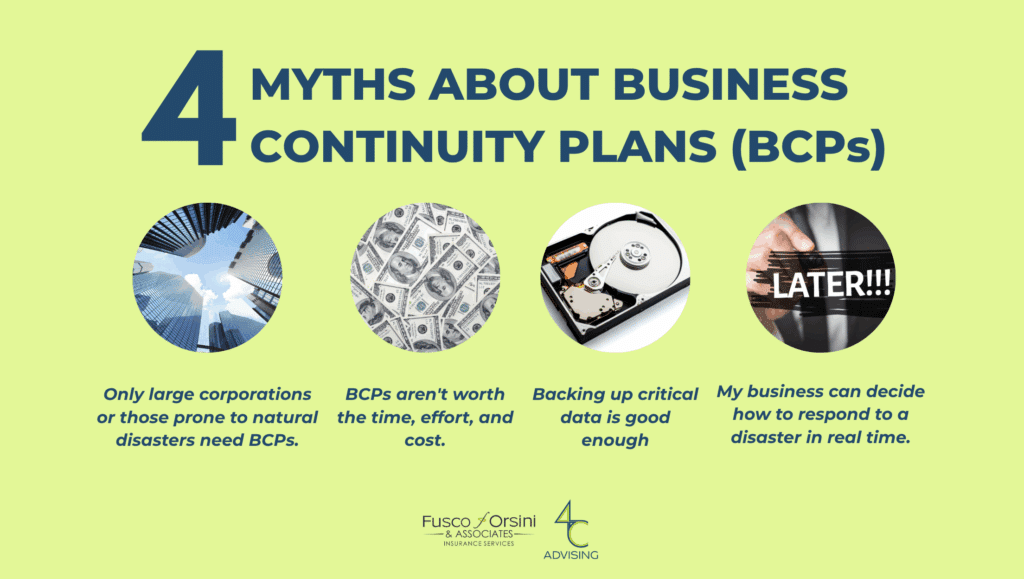
Myth: Business continuity planning isn’t worth it. My business can decide how to respond to a disaster in real time.
When a disaster strikes, time is of the essence. If you are faced with a catastrophe and have no plan, you will likely scramble to figure out the next steps. The more time you waste, the more likely the disruption and its domino effect (financial loss, reputational damage, regulatory penalties, etc.) will escalate. Can you imagine how stressful this situation could be for you and your employees?
If you want to get ahead of a potential disruption, please contact our advisory team so we can provide you with a business continuity plan example and discuss what a BCP can look like for your business.
P.S. – If you’re worried about the process being too technical or you simply feel uncomfortable looking at vulnerabilities face-to-face, we completely understand. Considering worst-case scenarios is never fun, but you can find freedom in having a plan moving forward.
Source: Zywave, Risk Insights, Business Continuity Planning Myths Debunked

Recent Post